

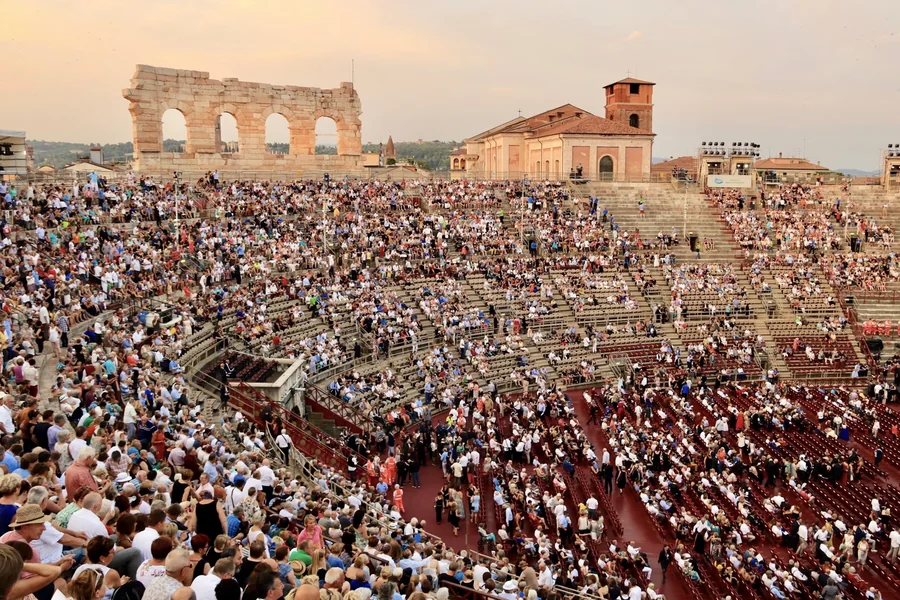
Every June, hours before the first note sounds in the Arena di Verona, thousands of people are already sitting on stone steps that Roman engineers laid down nearly two thousand years ago. They bring cushions, thermoses of coffee, and folding fans, and they wait – not impatiently, but with the practiced calm of people who know exactly what the wait is for. Nowhere else in Italy has turned the hour before a performance into such a deliberate, almost choreographed ritual.
That patience is not unique to opera. The same slow-burn tension shows up anywhere a crowd knows something good is about to happen – a stadium before kickoff, a poker table before the flop, or a screen glowing at 2 a.m. while someone waits on a spin at an online casino sankra. Verona simply built its version out of marble and thirteen thousand seats.
The Arena’s Century-Old Ritual of Waiting
The Arena has staged opera continuously since 1913, when Giuseppe Zenatello opened the season with Aida to mark Verdi’s centenary. What began as a one-off tribute became an annual fixture that now runs from mid-June through early September, drawing roughly 400,000 spectators across a typical season. The stone tiers hold up to 13,500 people on a full night, more than double the capacity of Milan’s La Scala.
Unlike an indoor house, where doors open twenty minutes before curtain, the Arena’s unreserved stone seating opens up to two hours early. Regulars treat that window as part of the show itself, not a delay before it.
Queuing for Stone Seats
Locals arrive with folded newspapers or thin cushions, because two millennia of wear have left the steps smooth but unforgiving. Vendors move through the growing crowd selling candles – a tradition dating to the 1930s, when the audience lit thousands of small flames as the lights dropped, a gesture now repeated every night the festival runs.
First-timers usually underestimate the queue. Seasoned attendees know the gates on Via Pallone fill fastest, so they position themselves there by 6 p.m. for an 8:30 p.m. curtain, treating the wait as a social ritual rather than an inconvenience.
The Unmarked Choreography of Newcomers
Tourists tend to cluster near the main entrance, unaware that seasoned locals split toward three separate gates to spread the crush. Within twenty minutes of opening, ushers with flashlights guide the crowd up worn staircases, and by sunset nearly every stone step carries someone settled in for a three-hour evening.
That settling-in period has its own etiquette – no running, no reserving blocks of seats for absent friends, and a quiet understanding that the person next to you may become a conversation partner for the next four hours.
| Detail | Figure |
| Founded | 1913 |
| Seasonal attendance | ~400,000 |
| Full-night capacity | 13,500 |
| Season length | Mid-June to early September |
| Ticket price range | €25–€230 |
Behind the Velvet: What Regulars Know
Veteran attendees carry small binoculars even for front-row seats, not because the stage is far but because the Arena’s scale makes facial expressions hard to catch from a hundred meters back. They also know which nights draw international casts, since programming shifts slightly year to year around anniversaries and revivals.
Many bring a second layer against the evening chill that settles over the amphitheater once the sun drops behind the surrounding rooftops, since stone retains daytime heat only for the first hour or two of an August night. Regulars also learn to pace their water intake, since crossing back through the crowd mid-performance costs a seat near the front.
Numbers Behind the Nights
The festival’s economic footprint stretches well beyond ticket sales. Hotels within walking distance of the Arena report occupancy above 90 percent on performance nights, and restaurants near Piazza Bra extend their kitchens until midnight to catch the post-opera crowd.
Candle sales alone generate a modest but steady revenue stream for local vendors, an unofficial tradition that has outlasted several changes in festival management since the 1930s. Local guides estimate that a single sold-out night can pull in well over a million euros once transport, dining, and lodging are counted alongside the box office.
Why the Wait Still Works
The Arena’s organizers have never rushed the pre-show ritual, and that restraint may be the point. A crowd given time to settle, watch the sky change color over the ancient walls, and light a candle in unison arrives at the opera already primed for spectacle – proof that anticipation, handled well, is not a flaw in the experience but its opening act.
That same lesson travels well beyond Verona’s stone tiers: whether the payoff is a soprano’s first note or a dealer’s final card, the wait itself is doing real work, tuning attention until the moment finally lands.
